Three coaching centers on the same street in Kota. All three prepare students for the same exam. All three put up a new syllabus page this month. Read them one after another and they say the same things, in the same voice, in the same order. That is not a coincidence. All three were written the same way, by the same kind of tool, in about eleven seconds each.
This is not something happening quietly in the background. In July 2026, Pew Research Center checked nearly half a million web pages to see how many were written with AI. One in ten showed clear signs of it. Among pages published after ChatGPT came out, it was more than one in three.
The same study found the giveaways. Em dashes doubled. Oxford commas went up 63%. The “it is not this, it is that” sentence pattern almost tripled. People have been reading this style for three years now. Many of them can spot it.
So put yourself in the parent's chair. Three pages, one decision, and nothing on any of them that the other two do not also say. What is that parent actually choosing between?
Why Content Alone Stopped Working
For twenty years, a good course page meant something. It took a senior teacher a full weekend to write. Publishing one showed effort, and effort suggested the institute was serious. Parents were never really reading it for information. They were reading it for proof that somebody had bothered.
That signal is gone, and your own students helped end it. A 2026 HEPI survey of 1,054 UK undergraduates found 95% now use AI in some way, up from 66% two years earlier, and 94% use it for graded work. These students are not an easy audience for AI writing. They write with AI every week. They know roughly how long your “complete learning journey” paragraph took to make.
Many of them will never open your page anyway. Pew's June 2026 survey of 5,119 US adults found 60% now read the AI summary at the top of search results, and about half use AI chat tools directly, up from 33% in 2024. Your page gets squeezed into two lines by a machine before a person ever sees it. Nice words do not survive that squeeze. Names, numbers, dates and qualifications do. That is worth knowing when you decide what goes on a page. We explained how this works in our guide to AI search and student discovery.
To be fair: using AI to write is not a mistake. Avoiding it only means doing slower work that looks the same. The mistake is expecting content to keep doing a job it can no longer do, which is convincing a stranger that you are worth their money.
What Trust Actually Looks Like Online
Trust is not a writing style. It is a set of facts that are hard to fake, placed where a doubtful person can check them. In education, three of them do most of the work. Notice that none of them is a writing problem.
Infographic 1 — The three signals, and what fakes each one
Results anyone can check
Numbers with the batch size shown.
Sounds like an advertisement
“98% success rate.” No batch. No total. No year.
Sounds like proof
“41 of our 96 students in the 2025 batch cleared. The year before, 12 of 88.”
Teachers you can see
Real people who answer for the teaching.
Sounds like an advertisement
A faculty page of stock photos and bios that all sound the same.
Sounds like proof
A named teacher, a record of questions answered, and a reply time you can prove.
Students who are talking
A batch that is visibly active.
Sounds like an advertisement
A WhatsApp group where the last message is a fee reminder from March.
Sounds like proof
Questions asked this week, answered by staff, where the whole batch can see them.
Every box on the green side comes from simply running your institute well. You cannot write your way to any of them. That is exactly why they still work.
The Trust Gap, Row by Row
Put a content-only approach next to a proof-based one. The difference is not writing quality. On the first row they tie. It is every row after that where they separate.
Infographic 2 — AI content only, compared with proof you can show
| AI content only | Proof you can show | |
|---|---|---|
| Time to publish a course page | Minutes | Minutes. Same tools. |
| How many rivals can copy it by Friday | All of them | None. They do not have your students. |
| What a doubtful parent can check | Nothing on the page | Names, dates, batch numbers, a QR code |
| What survives an AI search summary | Nice words, which get dropped | Facts, which get quoted |
| Who is responsible if it is wrong | Nobody | The teacher whose name is on it |
| How long it stays valuable | Until the next AI model arrives | Grows with every batch |
The last row is the one that should decide your budget. Content loses value the moment a new AI model arrives and everyone rewrites everything. A record of answered questions, a batch result, a certificate someone can verify: these get more valuable every term. There is more of them each year, and nobody can create them backwards.
Lessons from the Vacademy Ecosystem
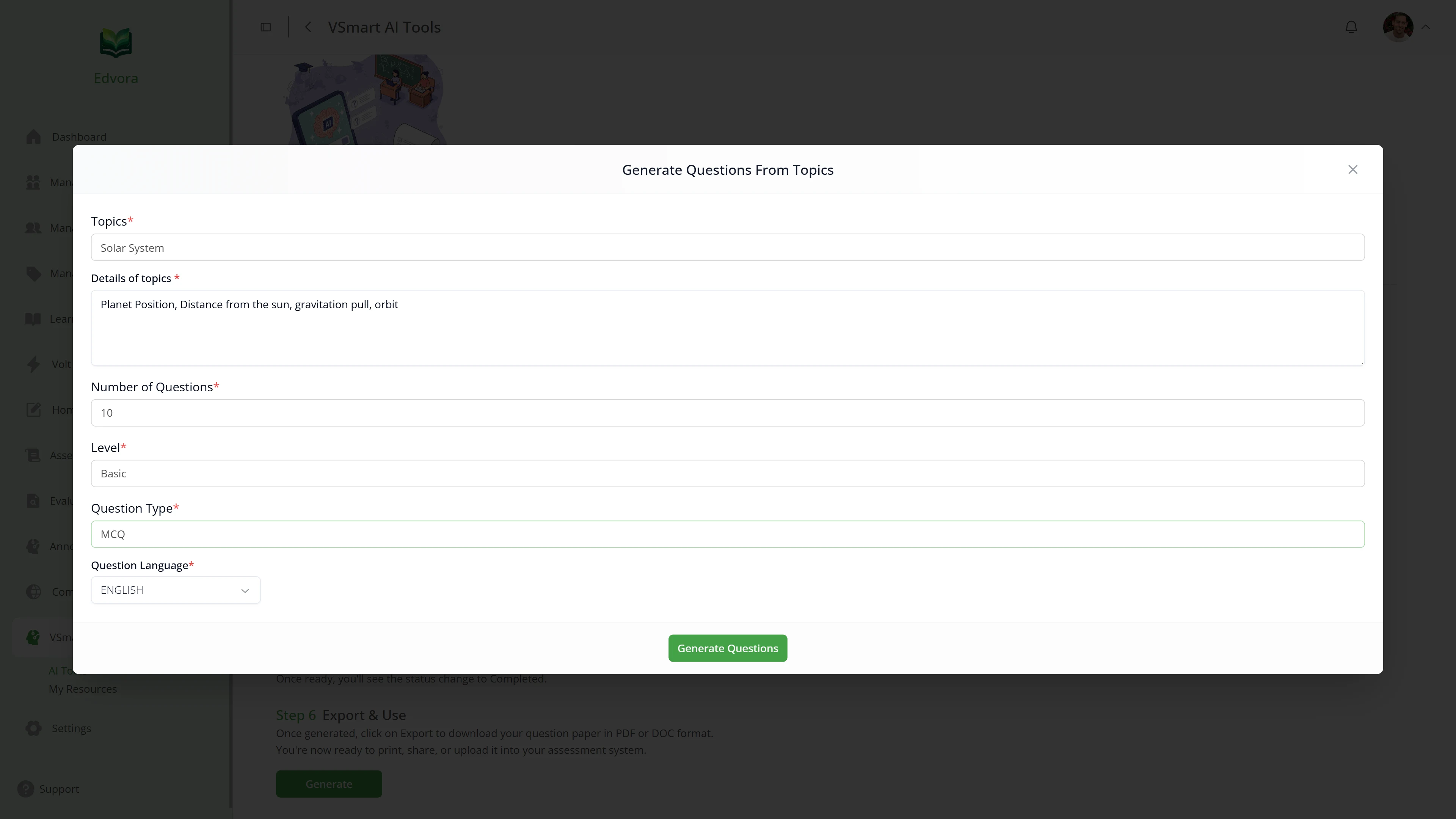
One thing should be said plainly. Vacademy sells AI writing tools, and pushes them hard. Vsmart makes question papers from a PDF, an audio recording, a chat message, a topic or an image, and builds whole courses from a short brief. So this is not an argument against AI content. It is an argument about where AI belongs in the process.
In Vacademy, AI writes the first draft and a real person owns the final version. Text stays fully editable, with no limits. AI-made videos and images can be regenerated twice, or replaced with the teacher's own uploads and YouTube links. Nothing goes live until a teacher publishes it. Four parts of the platform then turn ordinary daily work into proof.
1. Every question reaches a real person
Students raise doubts from inside any lesson, assignment or resource, without leaving the platform. The teacher is informed straight away. If the question belongs to someone else, it is passed to the right subject expert instead of sitting unanswered in an inbox.
That is the difference between a teacher who exists on a webpage and one a future student can watch working. For an institute, this is not a feel-good feature. Take a center with 600 students. On any ordinary day a few dozen of them get stuck, and most say nothing. Every one of those silent students is a fee that does not get renewed. Proper doubt support matters more than another explainer video for that reason alone.
Admins see every open, pending and answered doubt in one place. That is what makes a reply-time claim provable instead of just a nice line. If you want to say “doubts answered within four hours”, you need the record behind it.
There is a second use for this. When many students ask about the same topic, that topic is not being taught well, so your doubt list quietly becomes a list of what to fix. We compared the options in AI doubt chatbots versus normal Q&A.
2. Results with a record behind them
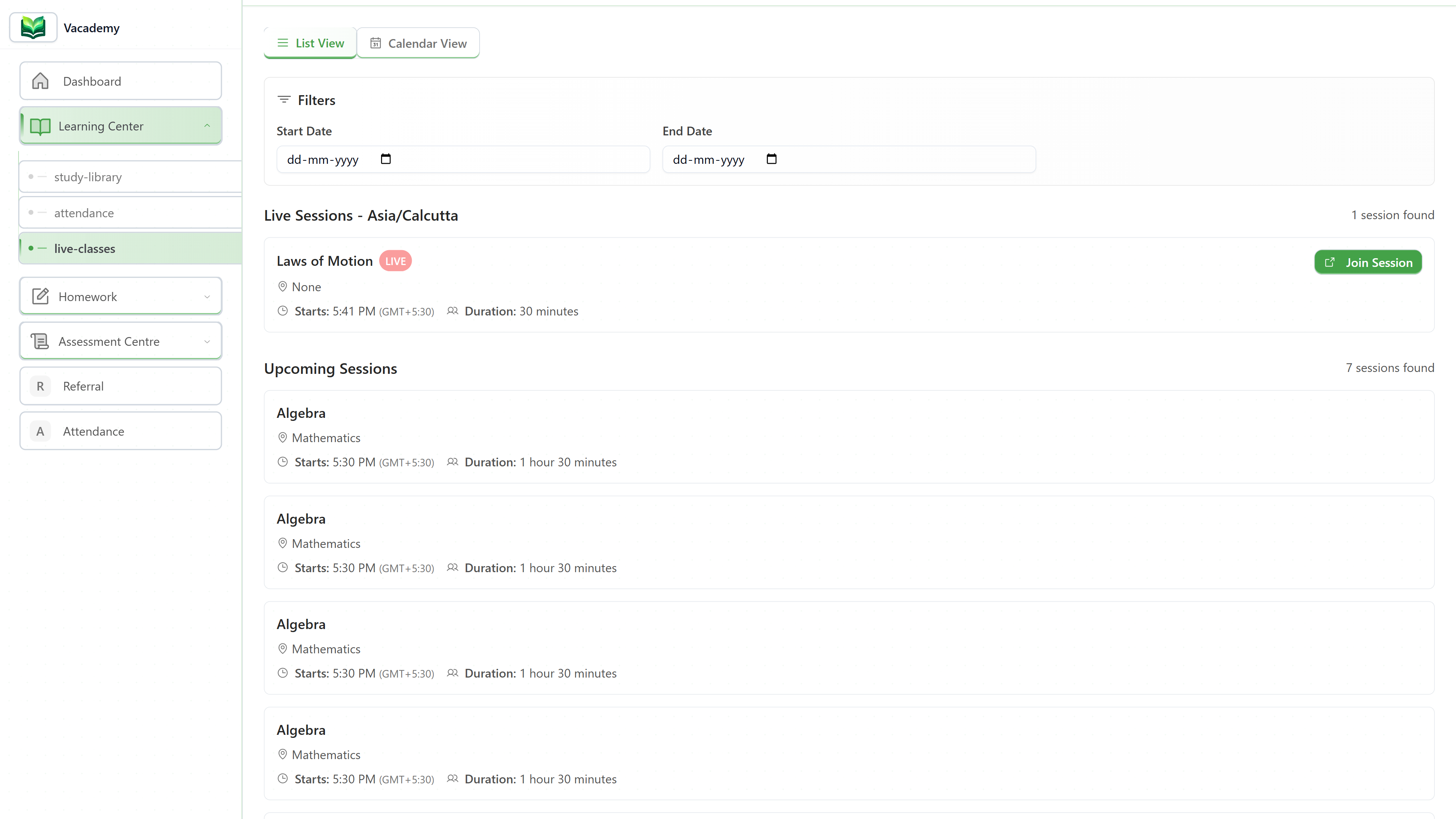
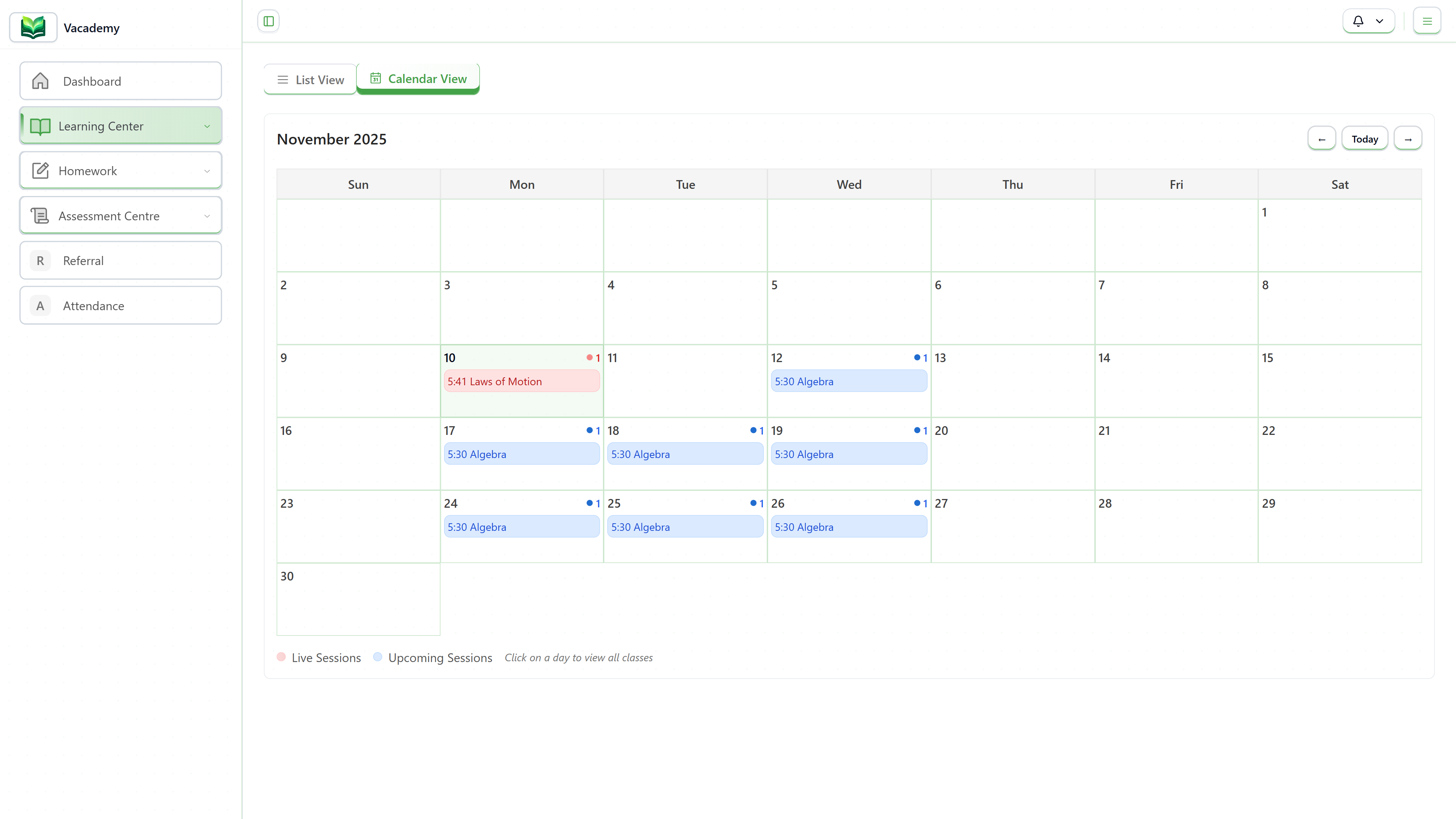
Live classes record who joined, when they joined and how long they stayed, and mark absentees without a roll call. Reports track progress across lessons, tests and tasks, for each student and for the whole batch. They reach students and parents by email or WhatsApp on a fixed schedule, not only at admission time.
A school that has sent parents weekly progress updates for two terms is not claiming to be transparent. It has already been checked, hundreds of times, by the people who matter most. Reports and analytics is where the result numbers you publish should come from.
3. Certificates anyone can verify
Certificates are created automatically once a student meets the rules you set: course completion percentage, compulsory modules, minimum test score, live class attendance, or a mix of these. Templates carry your logo, signatures, seals and a QR code. The QR code is the important part. It opens a secure verification page, so an employer or a college can confirm the certificate in seconds without calling your office. A PDF is a design. A certificate someone else can verify is a fact.
You set the rules
Completion, modules, test score and attendance conditions, set per course or per level.
Issued with no office work
Created the moment a student meets the conditions, on your own template.
Checked by outsiders
A QR code opens a secure page where employers and colleges confirm it is genuine.
See certificates and verification for the full list of rules.
4. Students talking where the learning happens
Batch and group discussion feeds sit inside the platform, along with pinned dashboard messages and announcements that go out on WhatsApp and email. The discussion stays attached to the batch it belongs to, instead of drifting into a group chat that nobody manages.
A future student who can see this term's class schedule, and the questions this week's batch asked, has more reason to join than any landing page can give them. We made the same case in why learners choose ecosystems over single courses.
A Trust Checklist for Institutes
Go down the right-hand column with your own website open. Anything you cannot answer in under a minute is a gap a competitor can walk through.
| What to show | Put this on your site | Ask yourself this |
|---|---|---|
| Teachers | Full name, qualification, years of teaching, subjects handled. | Search the name. Does anything come up outside your own website? |
| Results | Batch size, number of results, year. Always both numbers. | Can a parent work out the total without asking you? |
| Dates | A visible published date and updated date on every page. | Is anything on your site still advertising last year's batch? |
| Reply time | Your average doubt-answering time, taken from real records. | Could you show the record if a parent asked for it? |
| Students | Where your students talk, and who manages it. | Was the last staff reply this week, or last quarter? |
| Certificates | Certificates with verification built in. | Can an employer confirm one without calling your office? |
| AI use | Who checked and approved the material, by name. | Is a real person responsible for every claim you publish? |
Speed Gets Attention. Trust Gets Admissions.
Publishing quickly is the minimum now, not an advantage. Everyone competing with you reached that level months ago, using the same tools and often the same instructions.
What is still rare: a named teacher answering a question at nine on a Sunday night. A batch result you are willing to publish with the total next to it. A certificate someone else can verify. A group of students who are visibly talking to each other. Use AI to write. Then spend the time you saved on the four things AI cannot make for you.
Build an Institute People Can Check
Teachers, results, certificates and student discussion in one system, so your proof builds up while you teach instead of being written afterwards.
Frequently Asked Questions
Can students tell when course content is written by AI?
Very often, yes. They use the same tools. A 2026 HEPI survey of UK undergraduates found 95% use AI in some way. Students who write with AI every week know the style when they see it, and they treat it as a sign of how much care you put in.
How do you build trust when everyone's content looks the same?
Publish things that are hard to fake. Named teachers with real qualifications. A reply time you can prove from records. Results with the batch size shown. A student group a parent can look into before paying. Content shows you can write. These four show you can teach.
Is AI-written content bad for my institute's Google ranking?
Not by itself. Google judges whether a page is useful, not how it was made. The real risk is different. When a thousand institutes publish the same AI explainer, none of them stands out, and there is nothing on the page a parent or a search engine can verify.
How do I prove my results to a doubtful parent?
Always show the total. "41 of our 96 students in the 2025 batch cleared, compared to 12 of 88 the year before" can be checked. "98% success rate" cannot. Then make reporting a routine, not a sales activity: send progress and attendance to parents on a fixed schedule, not only at admission time.
Should institutes use AI to write course content at all?
Yes, for the first draft. AI is genuinely good at structure, question banks and lesson outlines, and avoiding it only means slower work. What matters is the next step. A named teacher edits it, owns it, and can answer for it when a student asks a question about it.
How does Vacademy help an institute build trust that can be checked?
It makes proof a by-product of daily work instead of a marketing project. Students raise doubts inside the lesson and a named teacher answers, with a record kept. Certificates carry a QR code an employer can verify. Attendance is captured automatically from live classes, and progress reports reach parents on a schedule.