Whatever breaks first is the distance between a scalable learning business and a very demanding job. Forty questions, five dimensions, one score out of 40.

Why Founder Dependency Feels Like Success
Founder dependency in business looks like demand — until it is the ceiling. Research on owner dependency finds buyers discount businesses that run through one person. Systems, not talent, separate a job from a scalable learning business.

Infographic 1 — The two-week test
Every line is a system that was never built.
The Five Dimensions of a Scalable Learning Business
The rule: if the honest answer is "the founder does it", mark it no. Acquisition pays back fastest — automate student follow-ups returns inside a quarter. Visibility is the hidden bottleneck: if nobody else can pull attendance, progress and fee visibility, every question routes through you.
Infographic 2 — What a "yes" means
A new enquiry
Someone calls, eventually
Contacted in 15 minutes
An instructor joins
Shadows you for a term
Templated batch, week one
A learner goes quiet
Noticed at month end
Churn signal fires early

Knowledge
Captured, or in one head?
- Every course has a written outline and outcomes.
- Teaching methodology is documented and replicable.
- Every module has a question bank with solutions.
- Recordings live in one tagged, searchable library.
- Every assessment type has a grading rubric.
- Institute IP sits in the platform, not a laptop.
- Common situations have a written escalation guide.
- New instructors find what they need without asking.
Acquisition
A system, or whoever remembers?
- Every lead is contacted within 15 minutes automatically.
- Leads are qualified by rules, not by luck.
- Follow-up cadence is set by the system.
- Every campaign has an attributable revenue number.
- One pipeline view updates in real time.
- Referral flows are structured, not ad-hoc.
- Discounts follow rules, not favouritism.
- Counsellors can be added without a training bottleneck.
Delivery
New instructor, same standard?
- Every batch runs on the same template.
- Attendance is captured automatically, not on paper.
- Assignment turnaround is measured in hours.
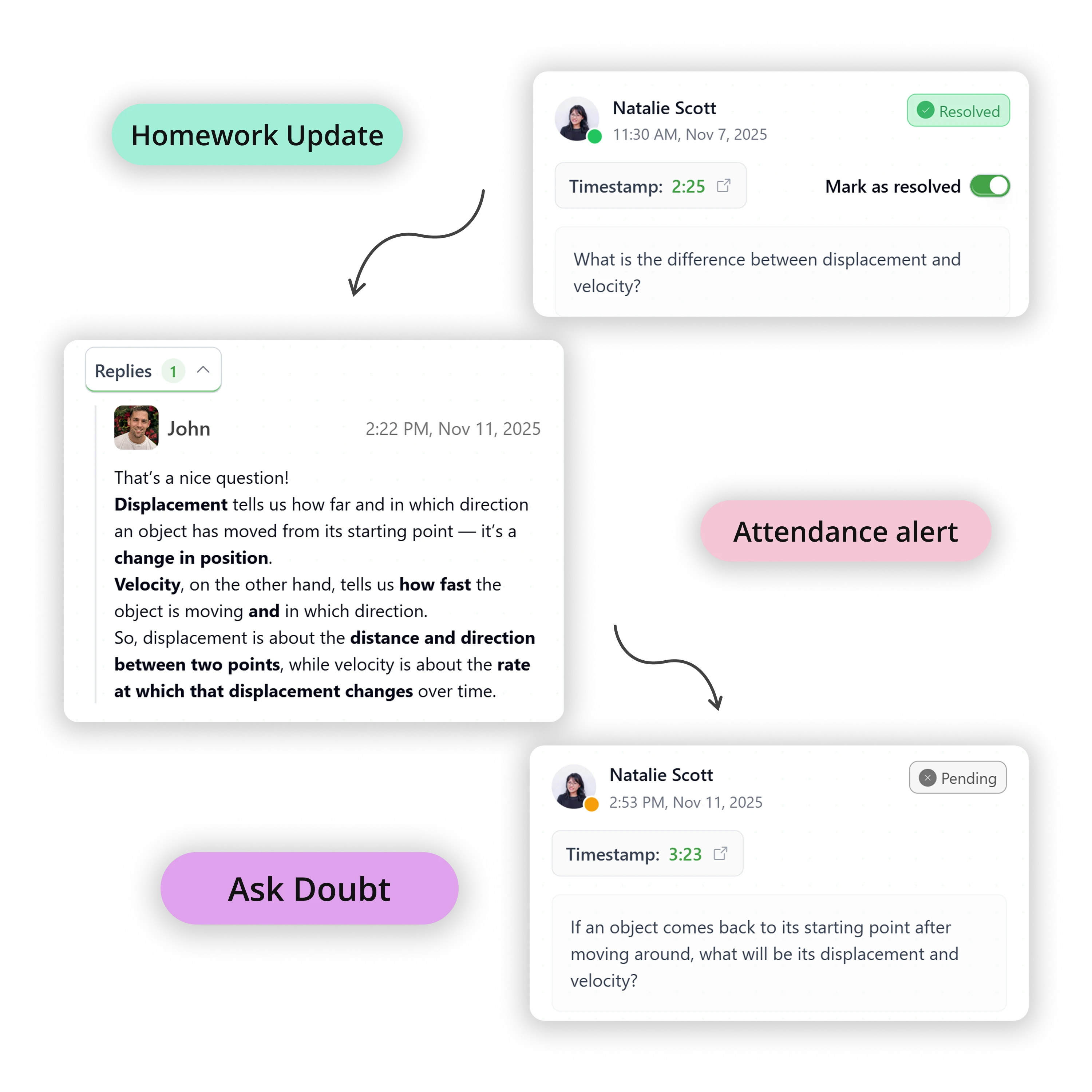
- Doubts run through a workflow, not WhatsApp.
- New instructors teach live from day one.
- Assessment scheduling is templated per programme.
- Reschedules happen without founder approval.
- Learner communications go out on schedule regardless.
Visibility
Dues and churn, unprompted?
- Attendance, progress and dues are visible unprompted.
- Churn signals arrive before the learner leaves.
- Parents see progress on their own dashboard.
- A weekly operations digest arrives automatically.
- Financials reconcile in the platform, not a spreadsheet.
- Teachers see cohort performance without asking IT.
- Fee collection status is real-time, not month-end.
- Any batch can be audited without notice.
Decisions
Rules, or mood?
- Pricing changes follow a written rule.
- Refund policy is codified and applied consistently.
- Escalation rules are written down, not remembered.
- Hiring criteria are documented, not intuition.
- Renewals follow a written policy.
- Batch launches follow a checklist, not instinct.
- Budget shifts are triggered by data.
- Large spend needs documented approval.
Scoring: Where Learning Business Automation Pays
Count the yeses. Read the noes as a queue — each names a piece of learning business automation you have not built yet, and they cluster.

Want your learning business automation plan?
What Each Score Band Does Next
Under 16 you get one action, not ten. Write the standard operating procedures for training institutes first — the case for documented processes holds here. Learning business automation cannot fix what nobody wrote down.
Infographic 3 — The score ladder
One rung per 90 days
Founder-Dependent
0–15One action only: automate lead follow-up.
Partially Systemised
16–27Get one new instructor running a batch without you.
Scalable
28–35Codify what you still decide by feel, then delegate it.
Transferable
36–40Formalise governance. Choose expansion, franchise or exit.
Learning Business Automation That Closes the Gaps
A coaching institute management system closes the most-failed items: automated follow-up, curriculum templates, live dues visibility, role-based access, and the ability to keep parents informed automatically. Then read how institutes systemised delivery before adding branches.
Optionality, Not Absence
Most founders who build a scalable learning business keep teaching — they stop being the only one who can. Coaching industry growth data shows demand outpacing any founder. Pick your band. Give 90 days to one thing.

Get Your Score, Then Your Plan
Walk the 40 questions through with a strategist. Leave with a scalable learning business plan for your band.
Frequently Asked Questions
How do I know if my learning business is founder-dependent?
Switch your phone off for 14 days. Anything that stops is a system you never built.
What does a scalable learning business actually look like?
A scalable learning business keeps knowledge, acquisition, delivery, visibility and decisions in systems. The founder can leave.
How do I document my teaching process for other instructors?
Record one delivery, transcribe, then abstract it into a template of outcome, method and rubric.
Which parts of a coaching institute should be automated first?
Lead follow-up pays back fastest. Learning business automation applied out of order creates work instead of removing it.
Can a coaching institute run without the founder teaching?
Yes, once teaching IP and onboarding are captured. Budget six to twelve months.
How long does it take to systemise a training business?
Three to six months per band. Your score sets both the priority and the timeline.